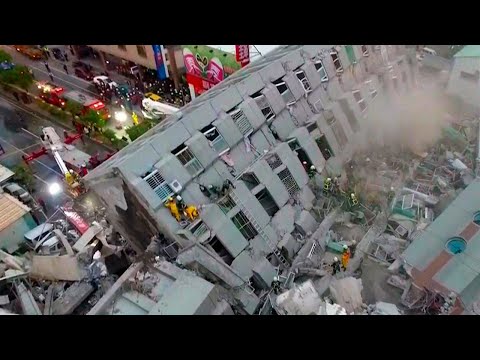
People run away, buildings are collapsed! A powerful earthquake rocks Japan
73,036 View

- Publish Date:
- December 13, 2025
- Category:
- Pearl Harbor
- Video License
- Standard License
- Imported From:
- Youtube
The Japanese archipelago, situated on the Pacific Ring of Fire, experiences frequent and varied seismic activity.
This geological setting results from the complex interaction of several major tectonic plates beneath the islands.
The nation maintains one of the world's most advanced and dense networks of seismic monitoring stations.
Data from this network is processed in real-time by the Japan Meteorological Agency (JMA) to issue prompt public alerts.
These alerts include the sophisticated Earthquake Early Warning (EEW) system, which provides seconds of critical advance notice.
The EEW system detects the initial, faster-moving P-waves to estimate the coming intensity of the slower, damaging S-waves.
Warnings are automatically broadcast via television, radio, and dedicated smartphone applications to reach the widest audience.
The primary goal of this system is to allow immediate protective actions, such as taking cover or halting sensitive operations.
Seismic intensity in Japan is measured on the JMA scale, which ranges from zero to seven and describes ground motion effects.
This scale provides a more tangible understanding of an earthquake's local impact compared to moment magnitude alone.
In addition to warnings, the JMA provides continuous information on aftershock probabilities following significant events.
This probabilistic forecasting helps guide public behavior and official response in the hours and days after a mainshock.
A cornerstone of Japan's resilience is its rigorous and continuously updated building code for earthquake-resistant construction.
These engineering standards are applied to everything from private homes and office towers to critical infrastructure.
Regular, nationwide disaster drills reinforce public knowledge of safe procedures for individuals, families, and organizations.
Communities often practice evacuation routes and assembly point protocols to ensure orderly response during actual events.
Local municipal governments maintain detailed hazard maps that illustrate areas at higher risk of liquefaction or landslides.
These maps are essential tools for urban planning and for informing residents about specific local dangers.
Tsunami preparedness is an integral and inseparable component of Japan's comprehensive earthquake response planning.
Coastal communities are equipped with clearly marked evacuation routes leading to designated high-ground shelters.
#earthquake #japan #landslide #taiwan #china #Yujing #miyakojima #yaeyama #Okinawa #naturaldisasters
A natural disaster is a serious adverse event caused by natural processes on Earth; examples include floods, hurricanes, tornadoes, volcanic eruptions, earthquakes, tsunamis, storms, rain, hail, wildfires, waves, wind, snow, weather, and other geological processes.
Earthquake today news:
Daily monitoring of earthquakes around the planet. Be aware of events
Did you miss our previous article...
https://trendinginhawaii.com/pearl-harbor/worlds-gone-mad-lefties-in-meltdown-over-pantones-color-of-the-year-decision